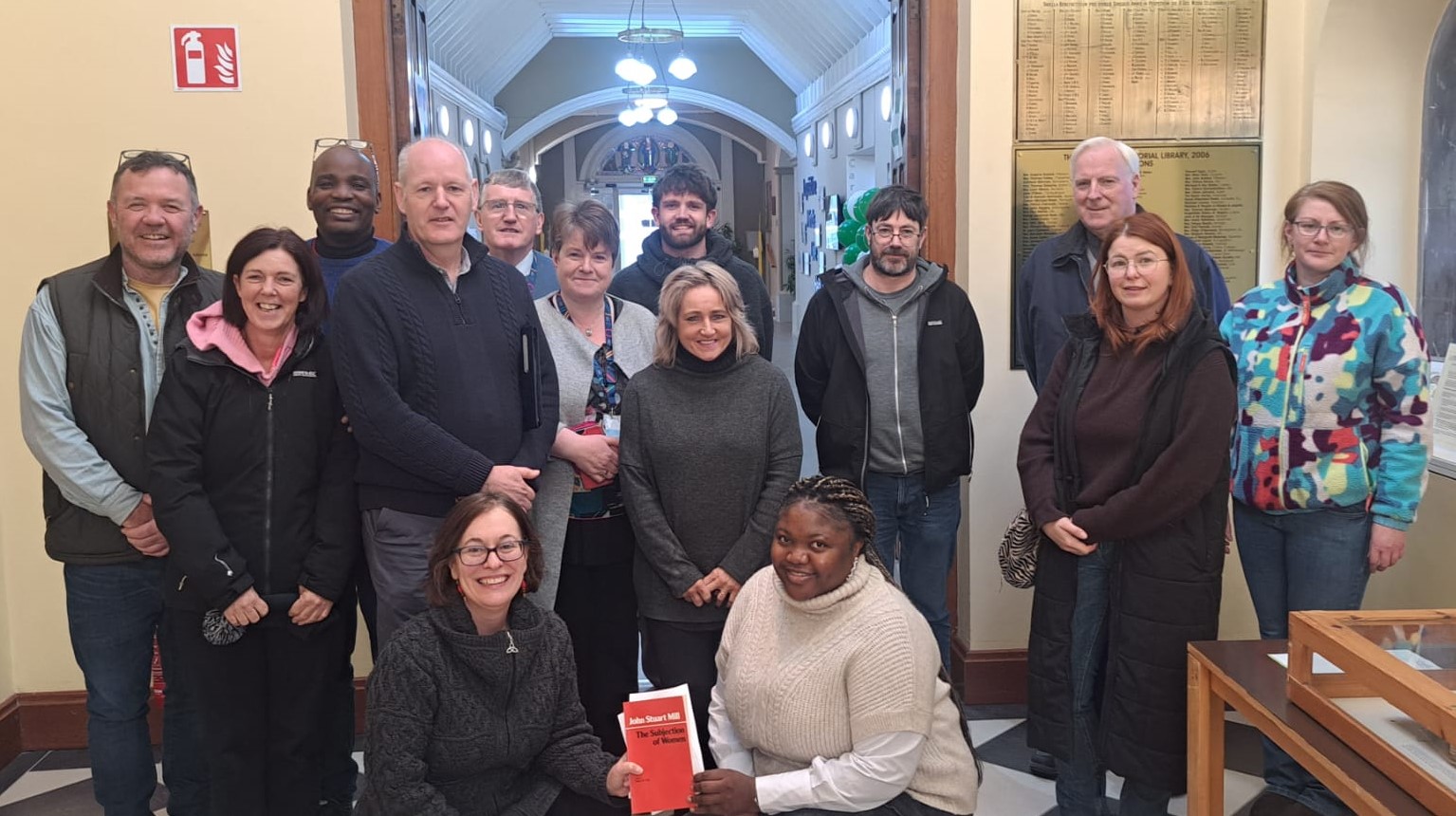
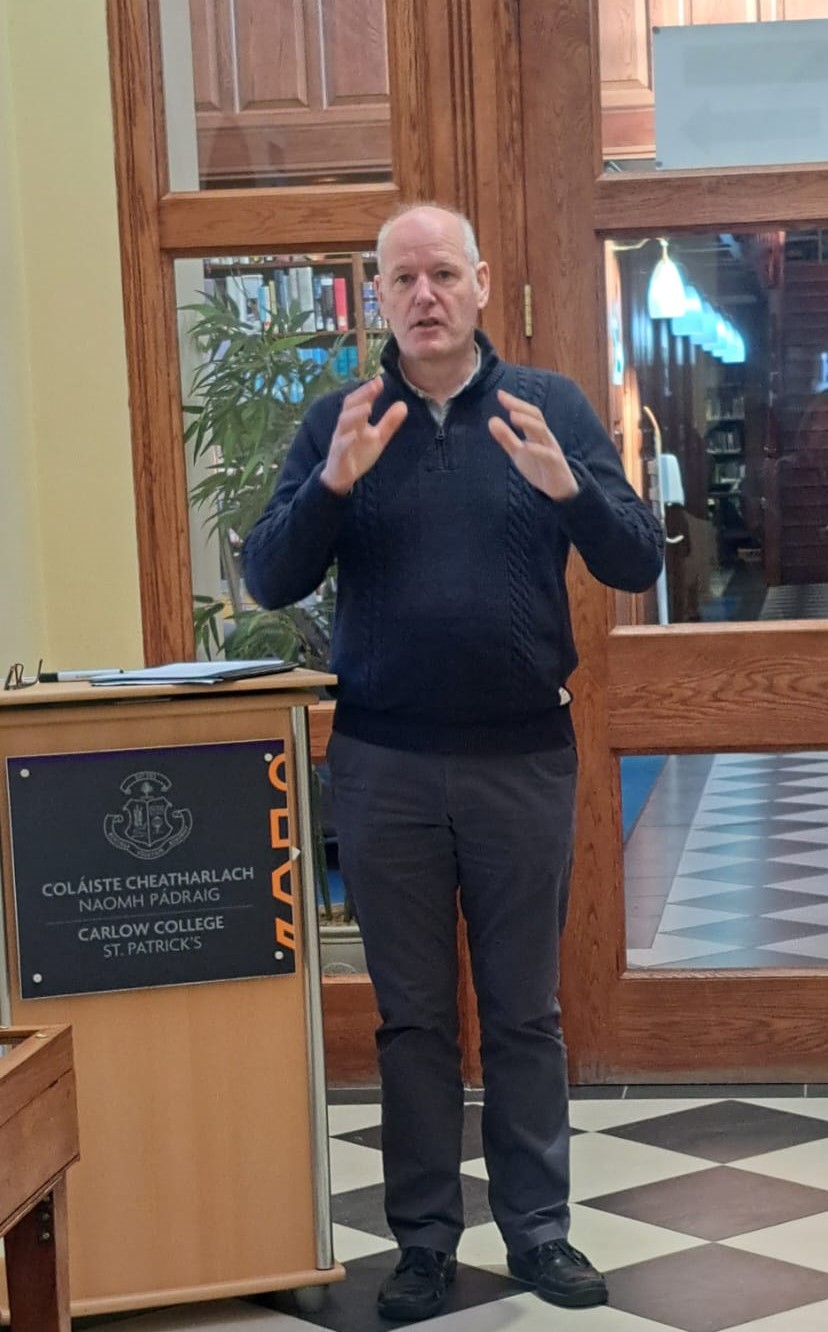
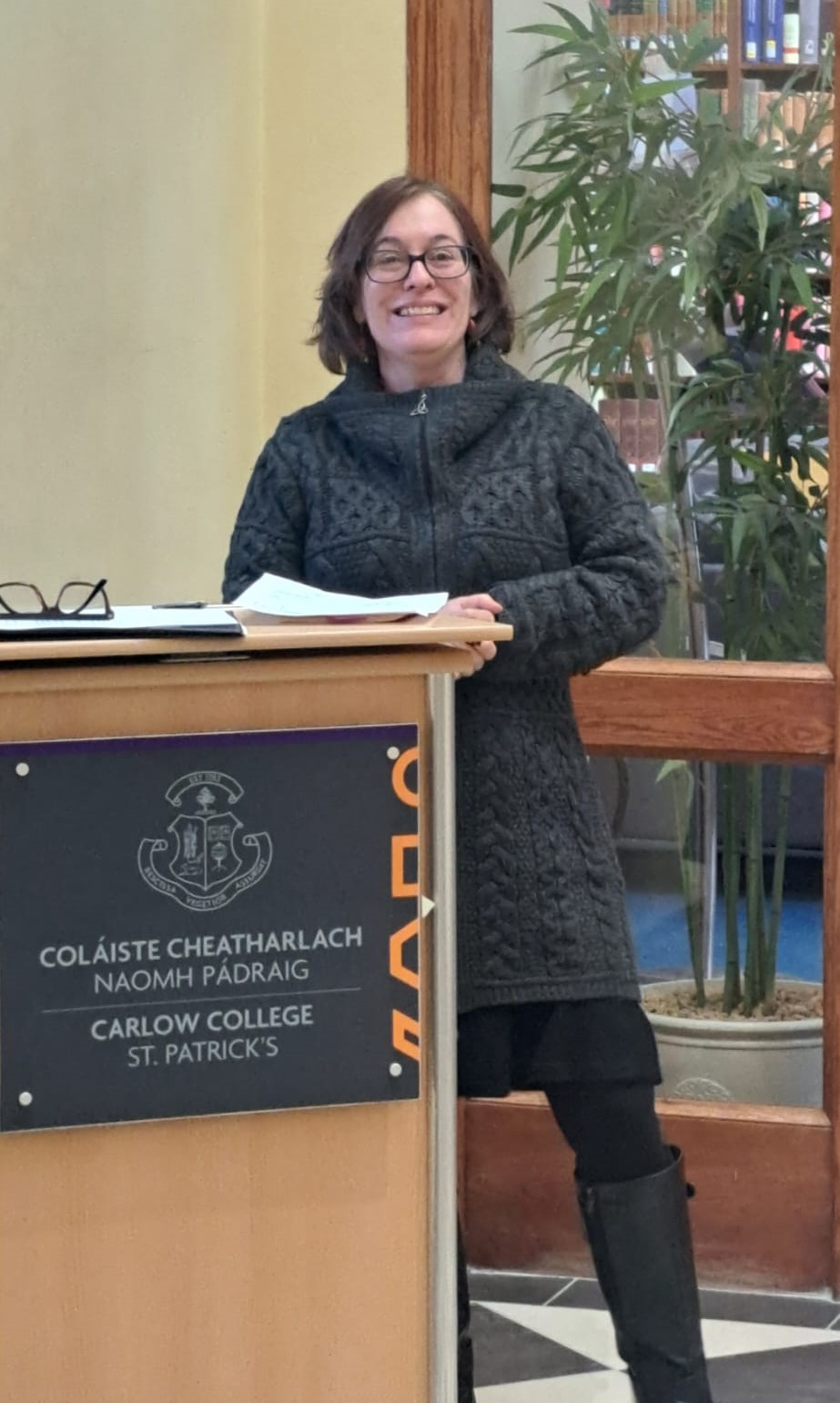
Carlow College celebrated International Men’s Day and World Philosophy Day by hosting a pop-up talk event featuring talks by Dr John McHugh discussing “I am a man who cares” and Dr Sarah Otten talking about “J.S. Mill: Liberal Feminist”.
The joint celebration was coordinated by the College’s EDI Team as part of their work to promote equality, diversity and inclusion with the College and through the College’s civic engagement initiatives.
The talks were attended by staff and students.
See below for transcripts of their talks.
Dr John McHugh: "I am a man who cares"
I am a man who cares
My title here is inspired by Lynne Truss’ (2009) book on punctuation called “Eats, Shoots and leaves”. As with that title, my title here can have more than one interpretation, depending on how punctuation is applied. Three different meanings lead my brief discussion in different directions, each concluding with a question (rather than an answer).
I am a man. Who cares? (socially)
I have always tried to be good, and on reflection, whenever my goodness was recognised or assessed, it was often done in a gendered way – Good Boy, Be a good boy…, Good man or perhaps ‘Be a man! So I have been conditioned to understand that I can be good at ‘being a man’, but I must confess, that I have never been sure what being good specifically as a man actually is. So, when I came across a clear and specific outline of what a Good Man is I jumped at Key Leigh Hagan’s (1997) description.
Hagan – Describes Good Men as follows:
“They listen more than they talk; they self-reflect on their behaviour and motives, they actively educate themselves about women’s reality by seeking out women’s culture and listening to women…. They avoid using women for vicarious emotional expression…. When they err—and they do err— they look to women for guidance, and receive criticism with gratitude. They practice enduring uncertainty while waiting for a new way of being to reveal previously unconsidered alternatives to controlling and abusive behaviour. They intervene in other men’s misogynist behaviour, even when women are not present, and they work hard to recognize and challenge their own. Perhaps most amazingly, Good Men perceive the value of a feminist practice for themselves, and they advocate it not because it’s politically correct, or because they want women to like them, or even because they want women to have equality, but because they understand that male privilege prevents them not only from becoming whole, authentic human beings but also from knowing the truth about the world…. They offer proof that men can change.”
Rather than simply accepting this as a checklist for ‘how good a man I am, I present it as raising the challenging question…
Question 1: Can men change, and do we think we need to?
I am a man who cares! (personally)
The things/people that I care about – care for – that are important to me, are as much to do with my personal identity, as they are to do with my gender.
bell hooks (American author, professor) explains that in order to achieve gender equality, we must also think about men, about their struggles, the barriers, choices, and consequences which make them who they are – and think of alternative ways for masculinity to be manifested. This alternative sort of masculinity is one
- That presupposes that it is enough for males to be in order to have value …
- That they do not have to perform in order to be affirmed and loved.
- That defining strength not as ‘power over’ … but instead that strength is one’s capacity to be responsible for self and others.
My next question is more reflective…
Question 2: Can I use my instinctual masculinity (protector, provider, and competitor) to progress towards achieving change in support of the things I care for and about?
I am a man who cares (professionally)
Research consistently shows that >20% in Health and Social Care professionals are male. There is a tendency for the largest proportion of male HSCW’s workers to occupy senior management roles (Impact UK, 2023))
There is nothing inherently female about the skills required by a good SCW, just as there is nothing inherently male about working as a construction worker or company manager.
In human services work the concept of “caring masculinities” can serve as a basis for common ground, both a vision and a target at the same time *(Scambor et al 2015) go on to say that the concept of “care” has to be widened in order to meet the needs and requirements of complex social realities….
As Niall Hanlon (2024). put it: A caring society is one that legitimates caring masculinities as valued identities for men and recognises that care and masculinity need not be mutually exclusive. It is a society that socialises care as a common concern.
Elliott (2016: 241) proposes that performing care work requires men to oppose traditional masculinity defined by traits such as domination, emotional suppression, aggression, and competitiveness, and to adopt caring masculinities with values and characteristics of care such as positive emotion, interdependence, and relationality’.
My final question is action focused for a college that is involved in the education and training of Social Care Workers…
Question 3: What are ‘caring masculinities’ and what do they look like in professional practice? How do we best support male SCW students and practitioners?
Elliott K (2016) Caring masculinities: Theorizing an emerging concept. Men and Masculinities 19(3): 240–259.
Hanlon, N., (2024) Masculinities and affective equality; the case of professional caring. Gender, Work & Organization, 31(5), pp.1676-1689.
hooks, b, (2004) The Will to Change : Men, Masculinity, and Love. New York :Atria Books
Leigh Hagan K (1997), “A Good Man is Hard to Bash: Confessions of an Ex‐Man‐Hater”. International Journal of Sociology and Social Policy, Vol. 17 No. 1-2 pp. 153–163
Scambor E, Bergmann N, Wojnicka K, et al. (2014) Men and gender equality: European insights. Men and Masculinities 17(5): 552–577.
Dr Sarah Otten: "J.S. Mill: Liberal Feminist"
When I was asked to give a talk combining World Philosophy Day and International Men’s Day, I told Bernie I was a feminist and focused on women’s experience. Men need to interrogate what masculinity means for themselves. But when I considered it, I thought of a male philosopher of whom I am very fond and who was a great supporter of women’s rights in his own day – so, I decided I would talk about him.
John Stuart Mill was born in 1806. He was a political philosopher and is most famous for providing the theoretical justification for liberal democracy. His book, On Liberty, (1859) champions the value of the individual and traces the implications of this for government. Unlike many of his contemporaries, he extended this equality of respect to women. His awareness of women’s plight in Victorian England started early. In 18bb, he was arrested for disseminating birth control information to working class women in London and spent the night in jail. He was sixteen.
His awareness of women’s disadvantage was sharpened in his early twenties when he met Harriet Taylor at a dinner party. Harriet was unhappily married to an older man, and agitated for the relief of women from the heavy legal disadvantages imposed by the state. At this time, married women existed under the legal system known as coverture which meant that a woman’s body, her children and any property or income she had, belonged to her husband. Until 1858, women had no access to divorce, and after that, much more discriminatory access to divorce than men. When Harriet’s husband died in 1849, and Mill was free to marry her, he first drew up a legal covenant where he repudiated the extra rights the legal system of England bestowed on him as a man.
In 1861 he wrote a book The Subjection of Women (Mill acknowledged many of the ideas came from his wife, and published in 1869). In the first paragraph, he says that ‘the principle which regulates the existing social relations between the two sexes—the legal subordination of one sex to the other—is wrong in itself, and now one of the chief hindrances to human improvement;’. What is of note in this quotation is that he sees the legal subordination of women not only as a harm to individual women, but to society itself.
Later, in chapter 2, he compares the situation of the married woman to that of slavery; ‘I am far from pretending that wives are in general no better treated than slaves; but no slave is a slave to the same lengths, and in so full a sense of the word, as a wife is.’ His point was not that all Victorian husbands were brutes, (in fact, many of them may have been perfectly amiable) but that the laws of the state made a woman, legally, worse off than a slave. She had no right to her body, no redress from marital rape and physical violence nor legal right over her children or property. When Mill became an MP (1865 to 1868), he agitated (unsuccessfully) for the extension of suffrage to women.
Mill died in 1873 and is buried beside Harriet in Avignon, France. The word ‘feminist’ did not exist at the time, but today we can describe Mill as a liberal feminist. He was a radical in his day. Today, men can claim the label feminist, and it is still a radical position.